HCE (Earwicker)
Finnegans WakeHCE (Earwicker) is at once a man pursued through the countryside, the subject of circulating reports that he has died or vanished, and an ancestral figure whose identity can expand into legend. His decisive significance lies in that instability: public accusation and rumor do not settle who he is, but multiply the versions of him that the narrative and its documents must hold together.
Identity and Public Pursuit
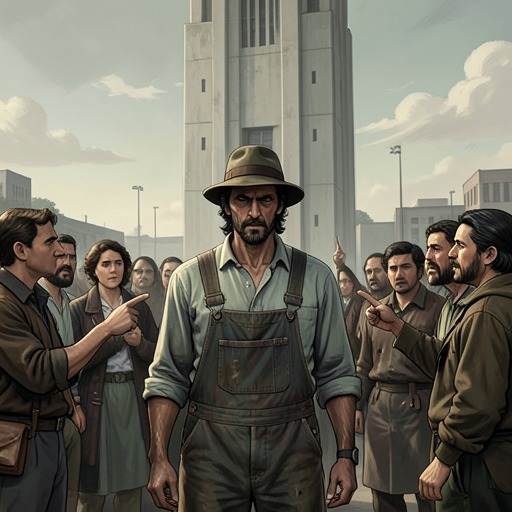
An account of HCE describes him as an elusive figure pursued by hounds across a chain of named towns and fields. The chase passes through places including Mullinahob, Peacockstown, Tankardstown, Raystown, and Horlockstown, doubling back toward Tankardstown before continuing through Cheeverstown, Loughlinstown, and Nutstown. The hunters lose his scent on a hill in winter, and he is said to have concealed himself in his lodging, sustained by rich food. The pursuit ends without his capture: the hounds return home, while HCE is associated with retreat, concealment, and survival rather than a decisive confrontation.
The narrative links his ability to withstand pressure to a deliberate change in routine. It describes the reeducation of his diet and his resistance to rich food as the answer that lets him outlast his pursuers. At the same time, violence and public hostility are said to have failed to dislodge the powerful shipping magnate and underlinen overlord. The episode thus sets bodily vulnerability against social prominence: HCE can be hunted and scrutinized, yet remains difficult to seize or reduce to a single account.
Death Reports and Disappearance
Rumor repeatedly turns HCE’s uncertain fate into apparent news. A report attributed to a newsletter says that he has laid hands on himself and died; the account then gives a confused sequence of public and family observances, including a three-day Saturnalia procession. The report concludes in silence, but does not establish a secure death. Instead, the narrative reverses it: HCE has fled the country again, traveling by concealed routes and ships, and is said to be living in Asia under a new identity and in another person’s body.
That supposed new life is itself unstable. The account imagines HCE in contrasting roles in a theater and on the street, then says that general astonishment and regret have put a term to his existence and that he has been recalled and discarded by the Maker. A private illness is offered as another possible cause of his end. Yet the same cluster of reports also describes him surviving a dangerous episode in a lily pond, where rescuers pull him from the water. None of these versions resolves the others. The repeated movement from death notice to escape, from disappearance to rescue, makes uncertainty about HCE’s fate a defining feature of his public story.
The Man and the Myth
The narrative resists treating HCE as merely a symbolic cipher. It insists that he must be regarded as an actual being, while also describing him as a figure whose existence can be understood through larger, geometrical forms. This tension matters: he is neither simply an ordinary individual nor only an abstract emblem. His story makes room for a person whose reality is constantly interpreted, enlarged, and contested by others.
A later quiz names Finn MacCool as the answer to a riddle built from images of a monumental, historical, and bodily figure. The identification places HCE within an Irish legendary register, but it does not erase his other identities. Instead, the name supplies another scale for reading him: HCE’s personal and public troubles can be retold as part of a much older heroic pattern. The narrative’s play among individual, ancestor, and giant-like figure reinforces its broader refusal to hold identity still.
The Document and Its Conflicting Signs
HCE’s instability is echoed in the writing associated with his name. The account describes an initial sign that is difficult to interpret and can be read in several ways, including as a title or as a mark paired with a consort. Numbers, shapes, and family emblems invite rival interpretations: a sign might suggest an inn, a bridge, a crossroads, or a family symbol. The text does not choose one definitive decoding; the abundance of readings becomes part of the evidence of how interpretation works in this world.
The document itself is described as altered and difficult to read, marked by incomplete traces, illegible flourishes, corrections, and conspicuous signs of error and omission. Its writing seems to invite repeated scrutiny, but closer attention does not guarantee a final answer. HCE’s name and story are therefore bound to a record that changes as it is read: the man is pursued through contradictory reports, while the page preserves contradiction in its very marks.
A Multiform Public Figure
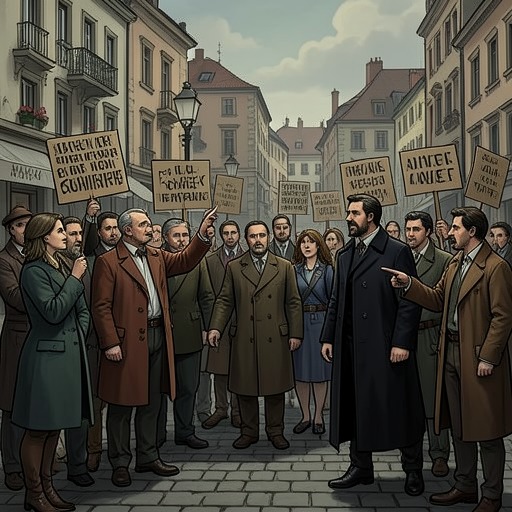
A mock publication title presents HCE as the object of an alleged scandal and of accusations said to be false. The title frames him as someone surrounded by accusers and public claims, while the surrounding account questions how a multiplicity of personalities and traits can gather around a single, stable somebody. His reputation is not a settled biography but a conflict among versions, allegations, and interpretations.
This structure also clarifies the larger narrative role of HCE. His apparent escapes, reported deaths, legendary enlargement, and unstable written record all return to the same problem: how can anyone establish a lasting account of a person when every witness, sign, and retelling alters the evidence? HCE endures not through a conclusive resolution of his case, but through the recurrence of the question itself.